|



A case of mind over matterDevices to read brain signals show promiseBoston Globe Apr. 18, 2006 |
Popular 
Trump Welcomes 'The Highly Respected' Alan Dershowitz Into The GOP, Shills His New Book

House Passes NDAA With Section 219 Aimed at 'Merging' U.S. and Israeli Militaries

Ben Shapiro: Trump Should 'Just Blow Up Kharg Island'

Sen. Graham Worked With Israeli Officials to Push GOP Senators to Pass Aid Package, Amb. Reveals

Netanyahu Confirms Plan to 'Merge' U.S. and Israeli Militaries

|
 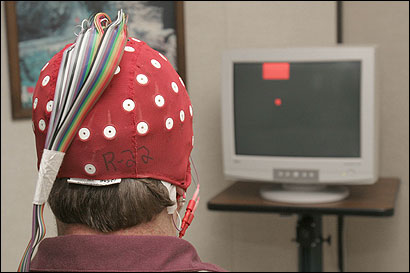 For nearly two decades, neuroscientist Jonathan Wolpaw has been using a powerful computer and a stretchy red cap to read people's minds. For nearly two decades, neuroscientist Jonathan Wolpaw has been using a powerful computer and a stretchy red cap to read people's minds.Wolpaw is a pioneer of ''brain-computer interface research," the science of picking up the brain's electric signals and translating them into information that can tell a device what to do. Week after week, volunteers in his Upstate New York public health laboratory put on a nylon mesh cap studded with electrodes and nudge a cursor around a computer screen simply by thinking. Now, with the help of medical engineers in Boston, Wolpaw is trying to convert his cumbersome laboratory apparatus into a household medical device for people so severely paralyzed they can't move even an eyelid. Given the aura of science fiction that surrounds brain-computer research, every finding triggers a wave of excitement. In 2003, a Duke University scientist attracted worldwide attention when he trained a monkey to move a robotic arm through wires implanted in its brain. But despite decades of laboratory success and millions of dollars in spending, the field has yet to bring a product to market. Brain-computer research stands as a reminder not just of the promise of medical technology, but the challenges of getting it to patients. Wolpaw's cap is part of a group of devices that have long been considered a potential boon to ''locked-in" people -- those whose minds are active inside immobile bodies. Even the most advanced of the devices are still in the experimental stage. In Foxborough, a small company has implanted an experimental neuron-reading plug in the brains of two paralyzed people, and another company in Atlanta is trying to develop a similar implant that helps patients speak. ''It's kind of 'Star Wars' stuff," says Scott Hamel, a volunteer who visits Wolpaw's lab in Albany three times a week to operate a computer with his mind. Surgically implanted systems, such as the ones being developed in Foxborough and Atlanta, use electrodes to pick up signals directly from a person's neural cells. A brain signal to curl the fingers, for instance, can be interpreted by a computer to push a pointer around a screen, or to control a prosthetic hand. By contrast, the cap used in Wolpaw's lab senses electrical waves outside the skull, the kind doctors have used for decades to monitor brain function on an electroencephalogram. The device interprets them with a sophisticated piece of software developed by Wolpaw and his team. ''We're not talking here about mind reading in the science fiction sense of the word," said Emanuel Donchin, a Florida brain researcher who worked on a Pentagon-funded ''biocybernetics" project that helped launch the field in the 1970s. ''You can't listen in on the conversations of the brain. You just make inferences about the state of the brain." Donchin developed the spelling system used in Wolpaw's lab and considers it ''very important" to bring such devices to patients. The technology's practical development has been hobbled by its origins deep in university research departments, he said. ''The people who do this research are basically scientists who have an interest in how the brain works, and they haven't really been thinking about or working toward commercial application," Donchin said. Recently, however, brain-computer research seems to be getting closer to jumping from labs to homes. As scientists become more adept at picking out key patterns of brain waves, faster computers have allowed test subjects to watch and respond immediately to the signals their neurons send. Cyberkinetics Neurotechnology Systems, Inc. of Foxborough is running a four-person clinical trial of its surgically implanted BrainGate device, and the company's founder, John Donoghue, says he plans to have it on the market by 2008 or 2009. Wolpaw hopes to have his cap working on four or five patients by June, and is exploring how to sell it commercially. ''It's an experiment that's becoming a reality," said Joseph Pancrazio, a National Institutes of Health official who funds brain-computer research. The technology improvements have helped attract more money, too. The National Institute of Neurological Disorders and Stroke, where Pancrazio works, spent $25 million last year on neural prosthesis research, nearly double the $13 million it spent in 2000. Money also comes from other parts of the NIH, as well as the Pentagon. For years, Wolpaw treated his brain-computer system as a research tool, and his lab is still funded chiefly by government grants. But after he and a colleague published a scientific paper in 2004 showing a patient could move a cursor in two dimensions, his phone rang. It was an executive from the Altran Foundation for Innovation, the nonprofit arm of a French technology-consulting firm, suggesting he should apply for the company's international engineering prize. He won the award, which brought more than $1 million worth of help from the company's engineers and consultants to determine how to bring the product to market. When the engineers arrived at Wolpaw's lab, they found a system virtually impossible for a real patient to use. Brain signals flow from a cap studded with 64 electrodes to a specialized amplifier, all of it run by a complicated computer system. The amplifier costs more than $10,000. And despite its complexity, patients could use the equipment only to perform simple test exercises. In the past nine months, engineers working with Wolpaw have streamlined the cap's design, found less expensive amplifiers, and developed a useful menu of icons that could allow the user to ask for medical help, control lights, or watch television. Their goal is to devise a system that costs less than $5,000, with a cap that's comfortable to wear not just for a short lab session, but for hours at a time. Last month, the improved system was given to its first test patient, a medical scientist with amyotrophic lateral sclerosis, ALS, who is losing control of his eyes, the last part of his body he can move. The cap replaced an older system that let him use a computer through eye movement. Within days, the scientist used his brain waves to type an e-mail and send it to Wolpaw's lab, and soon his messages were being passed enthusiastically between the lab and Cambridge Consultants, the Boston subsidiary of Altran helping to refine the system. ''When that first e-mail came to my computer, for a minute I couldn't say anything. I just sort of sat there and was bewildered by it, and then I had to go grab anybody who had any contact with the project and share it with them," said Mark Manasas, the project manager at Cambridge Consultants. But even if Cambridge Consultants manages to make the system inexpensive, simpler, and portable, it will still face serious marketing challenges. The number of patients who might benefit is relatively small -- chiefly those who suffer from advanced ALS or cerebral palsy, or with spinal injuries so serious that they have lost the ability to speak. Altran consultants estimated there are, at most, 170,000 such patients, many of whom have other problems that render them poor candidates for the device. The resulting group of patients represents a tiny market for any company looking to develop a new medical product. ''The market size has been the limiting factor for a lot of projects in the disabled area," said David Douglass, a medical-device investor with the venture capital firm Delphi Ventures. Wolpaw said his system needs considerable refinement. Not everyone can generate usable brain patterns, and it's not clear how many tasks the typical user might need it to perform. But numerous volunteers have shown that with practice, it not only works but becomes far easier over time. One of the most successful has been Scott Hamel, 43, a paraplegic who volunteered five years ago after seeing an advertisement at his gym. Hamel quickly found he could make the cursor climb the computer screen by imagining curling his toes, which he cannot move. When he relaxed, the cursor slid back down the screen. Today, Hamel says, he can move the cursor to hit targets on screen with nearly 100 percent accuracy. ''It's come to the point where with me, it's almost second nature," he said. Hamel, who drag races specially adapted cars and briefly held a New York State weightlifting record for wheelchair athletes, says he has ''a bit of a talent" for using the device. He called recent improvements in the machine ''staggering." ''If you can get [the device] in somebody's home and they're able to ask a caretaker for anything, or even be able to say 'Hi' when they walk into a room, that would be unbelievable," he said. |