|



Where worlds collide: Landfill to pollute what ''could well be the cleanest ground water on earth''Toronto StarApr. 08, 2006 |
Popular 
Trump Welcomes 'The Highly Respected' Alan Dershowitz Into The GOP, Shills His New Book

House Passes NDAA With Section 219 Aimed at 'Merging' U.S. and Israeli Militaries

Netanyahu Confirms Plan to 'Merge' U.S. and Israeli Militaries

Sen. Graham Worked With Israeli Officials to Push GOP Senators to Pass Aid Package, Amb. Reveals

Ben Shapiro: Trump Should 'Just Blow Up Kharg Island'

|
 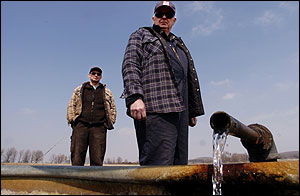 TINY TOWNSHIP—Gord Leonard slows his pickup to a crawl and points a finger out the window toward a piece of prime farmland gone to weed. He points from the road because he and others have been warned that setting foot on the property will land them in trouble. TINY TOWNSHIP—Gord Leonard slows his pickup to a crawl and points a finger out the window toward a piece of prime farmland gone to weed. He points from the road because he and others have been warned that setting foot on the property will land them in trouble.Behold, Site 41 — the "Unbelievable Site 41," according to a nearby protest sign — a moniker that may conjure, for some, visions of secretive military testing, Martians and flying saucers beneath a Nevada sky. While the sign hints at an element of mystery here, this 21-hectare parcel of flat fertile land northwest of Barrie, not far from the Wye River and abutting property that has been in the Leonard family for generations, is where human emotion and science have collided. Twenty-one years ago, the land was chosen as the best location for a dump to service the townships of Tiny and Tay, and towns of Penetanguishene and Midland. It was the 41st of 41 sites examined, thus the moniker. Leonard's son, Darrell, 35, who helps run the family's nearby tree nursery and is raising two boys of his own on the property, pipes up from the passenger seat of the pickup. "If that's such a top-notch site," he says, "it would have been in by now." Simcoe County is hoping the Ministry of the Environment will finally give a stamp of approval to the design, possibly within two months. On the ground, a stalemate continues. Aside from test wells, the land remains untouched and ringed by a fence sporting once red "No Trespassing" signs that have faded to light pink or nothing at all. Signs opposing the dump, however, are as vibrant as ever. Over the years, the Leonards and others have posted hundreds of signs, retained lawyers, held demonstrations, circulated petitions, screamed and yelled, but the most effective tools yet may be the water that bubbles up from the earth on Site 41 — gushes, in fact — and does in most places around here. That, and a professor with a lab in Germany that can measure even the slightest impurity. Turns out, the water, in a couple of respects, is more pure than Arctic ice. ______________ There's a faucet behind the farmhouse on Bill Shotyk's property, near Elmvale, south of the proposed dumpsite, that if left open, would run 24/7, gushing water out of the earth. Shotyk, director of the Institute of Environmental Geochemistry at the University of Heidelberg in Germany, is a "soils guy" with a world-respected, super-clean lab that can detect minute amounts of elements. In a study published this year, the Toronto-born scientist looked at bottled water and antimony levels, a heavy metal used to make the plastic polyethylene terephthalate bottles. He found the stuff is leaching out of the plastic into the water, and while the levels remain well within accepted levels, the study garnered global attention. In order to test the levels in the bottled water, he needed a benchmark, and chose to test the water from a number of sites near his farm, including the tap on the farm, as well as a flow across the road from Site 41. He was astounded. The lead levels in some tests were below what has been measured in Arctic ice. The water he tested directly south of the site, taken from a flow feeding a cattle trough that was drilled in 1940, measured less than one part lead per trillion particles. Tests on Arctic ice core samples that were older than 5,000 years have found levels of lead five times higher. As for the antimony, the average in the spring water was two parts per trillion. The bottled water he tested ranged from 100 to 1,000 times higher than that. "This could well be the cleanest ground water on earth," says Shotyk. Rob McCullough, manager of Environmental Services for Simcoe County, points out that Shotyk's study was limited. "Not to say it's not clean, it is clean water, but he's only talking about two specific parameters — lead and antimony." It's part of McCullough's job to try to get past the emotions, and educate the public about the dump and the proposed plan. The land is flat, with a layer of soil sitting above a layer of sand and clay, which keeps a natural cap on an aquifer with an upward gradient. Poke a hole through the clay, and water comes bubbling up. The plan calls for an initial and extensive dewatering of the site into a nearby creek. The waste, once the garbage cell is completed, would sit below the clay, and above several protective layers, including a leachate collection system and liner. The upward water pressure below all this would keep the garbage and leachate in place. Test wells around the site will monitor for contaminated water. "We can rhyme off a litany of protective factors, and it comes up against emotion," says McCullough. "It's a hard thing to address." ______________ During some 16 years on county council, Garfield Dunlop had been a proponent of Site 41. After the Walkerton water tragedy in 2000, Dunlop, who took over the provincial Simcoe North seat in 1999, started listening to constituents who were against the dump. The Conservative MPP took his first tour of the site in on a February day in 2001. Right in the middle of Site 41, where the garbage would go, the cap on a test well had been "blown off" — or purposely been removed, depending on who you ask — and "I'm telling you, there was water gushing out of pipe. I just could not believe it. I thought, `How did this ever get to this position? How did we approve this? And how did the ministry approve it? With all this water in the ground?'" With that, Dunlop joined the opposing camp, and has presented petitions to the Legislature and authored a private member's bill that, if passed, would declare the site off-limits. ______________ "Who Will Stop The Political Poisoning" of the water, asks one of the protest signs. George MacDonald, mayor of Midland, former warden of the county and a proponent of Site 41, believes there's plenty of politics going on and that the Ministry of the Environment must make a call on landfills. "If somebody says to me tomorrow that Site 41 is not an option as far as the MOE is concerned, then send me a cheque for about five million bucks that I've spent, and then tell me where we're going to go with the waste. I'm easy, okay, the world goes on. "We just sit here, waiting from month to month," he says. The county estimates about $10 million has been spent on Site 41, including land and design. The county has also adopted a no-import/no-export waste policy. So, as site after site in the county fills with garbage, the pressure builds for another. The project received a provisional environmental assessment approval certificate in 1998, but it was issued with a number of conditions. An environment ministry spokesman said the project is at the final review stage. ______________ Darrell Leonard knows the garbage has to go somewhere. His boys, aged 5 and 7, are aware of the fight he and their grandfather are helping to wage, and have also taken an interest in pumpkins. Darrell shows a photo of the boys posing with one that came from the land last year. Weighed in at 538 kilograms — the sixth heaviest ever recorded in Ontario. "The dad grew that one," jokes Darrell, which the kids claimed as their own, and named Spiderman. "We like to say," says Gord Leonard, "it's the good water here that makes them grow." |