|



WSJ: Europe's Tax Lesson: VAT Rates Start Low, Rise; Income Tax Rates Remain HighPaul L. CaronTaxProf Blog Apr. 15, 2010 |
Popular 
U.S. Must Prep to 'Welcome Large Numbers of Jewish Refugees,' Pro-War Lobbyist Mark Dubowitz Says

Israel Lobby Seeking to Revamp U.S. Aid as 'Partnership' Immune to Political Shifts

Israel Lobby Ousts Thomas Massie From Congress in Most Expensive Primary Race in History

Ben Shapiro: The Israel Lobby Didn't Target Massie Because Of His Opposition to Israel

Thomas Massie vs. The Israel Lobby

|
 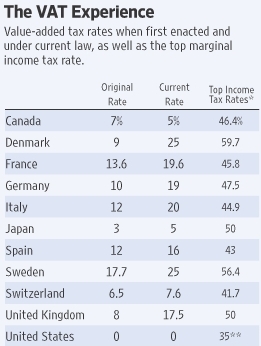 As Americans rush to complete their annual tax returns today, there is still some consolation in knowing that it could be worse: Like Europeans, we could pay both income taxes and a value-added tax, or VAT. And maybe we soon will. Paul Volcker, Nancy Pelosi, John Podesta and other allies of the Obama Administration have already floated the idea of an American VAT, so we thought you might like to know how it has worked in Europe. As Americans rush to complete their annual tax returns today, there is still some consolation in knowing that it could be worse: Like Europeans, we could pay both income taxes and a value-added tax, or VAT. And maybe we soon will. Paul Volcker, Nancy Pelosi, John Podesta and other allies of the Obama Administration have already floated the idea of an American VAT, so we thought you might like to know how it has worked in Europe.A VAT is essentially a national sales tax that is assessed at each stage of production, with the bill passed along to consumers at the cash register. In Europe the average rate is a little under 20%. (See the nearby chart.) In the U.S., a federal VAT would presumably be levied on top of state and local sales taxes that range as high as 10%. Some nations also exempt food, medicine and certain other goods from the tax. VATs were sold in Europe as a way to tax consumption, which in principle does less economic harm than taxing income, savings or investment. This sounds good, but in practice the VAT has rarely replaced the income tax, or even resulted in a lower income-tax rate. The top individual income tax rate remains very high in Europe despite the VAT, with an average on the continent of about 46%. |