|



Ft. Lewis Soldier Refuses Deployment To Iraq: ''Although I have tried to resign out of protest, I will be forced to participate in a war that is manifestly illegal. As the order to take part in an illegal act is ultimately unlawful as well, I must as an officer of honor and integrity refuse that order.''Komo TVJun. 07, 2006 |
Popular 
Ben Shapiro Pushes Noahide Laws at TPUSA Event, Throws a Fit Over Being Quoted Word-For-Word

From Aid to Dependency: Israeli Agent Reveals the Real Goal of 'Merging' U.S. and Israeli Militaries
House Passes NDAA With Section 219 Aimed at 'Merging' U.S. and Israeli Militaries

ADL, Jewish Groups Lobby California to Classify Jews as a Race, 'Not Just a Faith'

Netanyahu Confirms Plan to 'Merge' U.S. and Israeli Militaries

|
 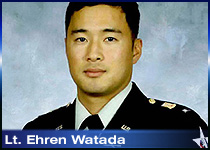 Komo News Video Report Here PIERCE COUNTY - An Army lieutenant says he's prepared to face the consequences of his decision not to deploy to Iraq with his Fort Lewis Stryker brigade. First Lt. Ehren Watada, who turns 28 Thursday, could face at least two years in prison for failing to obey an order to deploy, the officer said Wednesday evening during an Associated Press interview. "I know that my case has brought a lot of attention and scrutiny on me by my superiors. Also, I'm probably very unpopular, if not the most unpopular person on Fort Lewis. But I know out there there are people who believe in what I'm saying," Watada said. Watada is a member of the 3rd Brigade, 2nd Infantry Division, the Army's first Stryker Brigade Combat Team. The unit is set to begin leaving later this month for a second mission in Iraq. This would be Watada's first deployment to Iraq. Watada, a native of Honolulu, joined the Army in March 2003, he says, out of patriotism, love of his country and a willingness to serve others. In fall 2005, he learned he would be sent to Iraq. On the advice from a commander he said told him a soldier should know "everything you can about war," Watada began researching the reasons for U.S. involvement in Iraq. Based on his study of papers by international and constitutional law experts, as well as documents from governmental and non-governmental agencies, he said he concluded that the war in Iraq is illegal and immoral. "We have violated American law," Watada told The AP, adding he believes that with respect to the question of whether Iraq had weapons of mass destruction, intelligence was manipulated "to fit a policy that was already implemented prior to 9-11 and prior to the invasion." "We can't break laws in order to fight terrorism," he said. Watada has come under intense public scrutiny in recent days after he announced he would not leave for Iraq with his brigade. "I certainly feel like I'm taking an enormous risk, sacrificing an enormous amount, and I have little to gain personally. But I'm doing what I feel is the right thing," he said. "It is a sacrifice I'm willing to make on behalf of the soldiers whom I was sworn to protect and serve," in hopes they soon will no longer be forced to participate in the Iraq war and can return safely to their families. Peace activists, some veterans and some clergy have come out in support of Watada, whose commanders barred him from attending a scheduled noon news conference Wednesday because it occurred during his duty hours - 6:30 a.m. to 5:30 p.m. In a video played at the news conference, he said it was his "duty as a commissioned officer of the United States Army to speak out against grave injustices. My moral and legal obligation is to the Constitution and not those who would issue unlawful orders." Watada said the "war in Iraq is not only morally wrong but a horrible breach of American law. "Although I have tried to resign out of protest, I will be forced to participate in a war that is manifestly illegal. As the order to take part in an illegal act is ultimately unlawful as well, I must as an officer of honor and integrity refuse that order." And he added, "The wholesale slaughter and mistreatment of the Iraqi people with only limited accountability is not only a terrible moral injustice but a contradiction to the Army's own Law of Land Warfare." In a letter to his command in January, Watada said he had reservations about the Iraq war and felt he could not participate, his lawyer, Eric A. Seitz, told The AP in a telephone interview Tuesday from his office in Honolulu. A couple of months later, at the Army's suggestion, Watada resubmitted his request to resign, Seitz said. The lieutenant was told last month that his request had been denied. Wednesday evening, Watada told reporters he will soon submit another request to resign but added, "I feel it is inevitable ... I will be charged and I will be punished." He added such punishment would be "no more and no less" than the sacrifices of the soldiers serving in Iraq. The Army said Wednesday his request to resign was denied because Watada's current unit is in a stop-loss category, and he has not fulfilled his service obligation. His commission requires that he serve as an active-duty Army officer for three years ending this Dec. 3, his lawyer said. Watada's decision to publicly declare his intent to disobey orders "is a serious matter and could subject him to adverse action," Army officials said in a statement Wednesday. "No decision regarding personnel actions involving 1st Lieutenant Watada will be made until a thorough review by his commander occurs in accordance with military law." Paul Boyce, a spokesman in the Army's national public affairs office, said Tuesday that Watada is "not the first officer, not the first enlisted, nor the first soldier" to refuse deployment to Iraq. An Army fact sheet dated Sept. 21, 2005, the most recent one available, said 87 conscientious objector applications had been approved and 101 denied since January 2003. Watada, who is opposed only to the Iraq war, did not apply for conscientious objector status. He said Wednesday evening he wouldn't object to going to Afghanistan. Army regulations define conscientious objection as a "firm, fixed and sincere objection to participation in war in any form or the bearing of arms, because of religious training and belief." Anti-War Groups Coming To His Aid Anti-war groups are latching onto Watada's stand. "It's going to be I think quite possibly a huge shift," said war protestor Miriam Hill. "This is leadership at its utmost." Former Army Lt. Col George James, who's now an anti-war activist, salutes Watada. James resigned his commission three years ago for the same reasons. "I met with him Sunday as a group," James said. "I think he's one of the most courageous guys I can think of." Fellow soldiers say Watada should be court-martialed and punished. "I don't think it's right," said Sgt. First Class Daniel Watts. "He is wearing the uniform and he should go. That's what we signed up to do." Army veteran Gerald Johnson added, "Whether it's unjust or just, we're still there and we've got to defend this country and that's his job. So if he's not going to go, let's court martial him and put him in jail and then send him on his way." |