Licensing laws have been proven to be an effective government mechanism for reducing free market competition, consumer options and employment opportunities. Features Walter E Williams, Paul Avelar and Jestina Clayton. http://www.LibertyPen.com
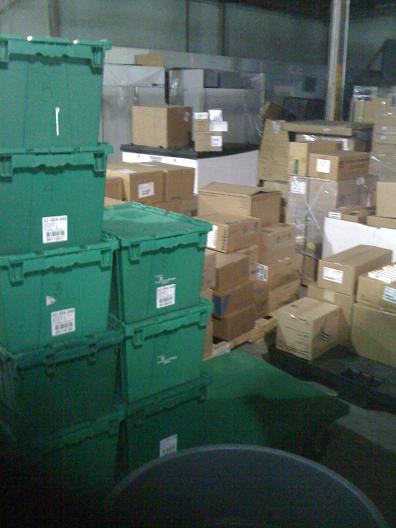
"This is $750K of government supplies going in the trash due to expiration. We buy it, hold it until it expires, and throw it away. This is a monthly routine."
"Don't want to get too specific, but they are supplies that are held for contingencies (disasters etc.) in the US.... (more)
Economic data over the past weeks, punctuated by last week's dismal employment reports, confirm the diminishing impact of the stimulus efforts orchestrated by the Obama Administration and the Federal Reserve. In what must be a huge disappointment to Keynesian enthusiasts, the record doses of both monetary and fiscal narcotics did not produce the desired results. In fact, the size and scope of the "recovery" of the past two years was weaker than would have been expected in a typical busin... (more)
No matter how bad the economy gets, governments at all levels will always put their own petty authority ahead of productive market activities. An example is the Batesville Store in rural Albermarle County, Virginia, which was closed -- without notice or due process -- by a local bureaucrat who decreed the store, which was being used primarily as a restaurant and live music venue, had too many seats. The store’s owners explained:<... (more)
Sometimes I swear we are living in a dystopian novel whose author is courteous enough to provide us mere extras in his story with plenty of comedic relief to make the days tolerable. The USA Today headline reads: “Obama, Biden again target government waste.” Yes. That’s in fact what it says. The administration that has given us a $3.7 trillion ... (more)
The New York Times’ account of Cuban cyclist Damian Lopez Alfonso could help Americans regain their faith in a free-market healthcare system.
When he was 13, Lopez was electrocuted while trying to retrieve a kite caught in some power lines. Doctors were able to save his life but not his forearms. His face was also horrib... (more)
SPIEGEL: Mr. Shikwati, the G8 summit at Gleneagles is about to beef up the development aid for Africa...
Shikwati: ... for God's sake, please just stop.
SPIEGEL: Stop? The industrialized nations of the West want to eliminate hunger and poverty.
Shikwati: Such intentions have been damaging our continent for the past 40 years. If the industrial nations really want to help the Africans, they should finally terminate this a... (more)
There is a great deal of uncertainty among investors about what the future of the U.S. economy may look like – so I decided to take a stab at what’s likely to happen over the next 20 years. That's enough time for a child to grow up and mature, and it's long enough for major trends to develop and make themselves felt.
I’ll confine myself to areas that are, as the benighted Rumsfeld might have observed, “known unknowns.” I don’t want t... (more)
Fed Chairman Ben Bernanke is troubled by the unemployment rate that has crept back upwards, and the "frustratingly slow" economic recovery. And so what does he propose? More of the same, of course. More liquidity and a base interest rate kept near zero.
You see, this is practically the only tool he has: monetary stimulus, which is another word for infl... (more)
Let’s face it: As I have been repeatedly predicting for the last several months, the Republicans are going to cave when it comes to the raising the debt ceiling. Republicans always cave when it comes to principle. Their caving stretches all the way back to the New Deal, when they realized that to please voters, they would have to cave and embrace the welfare-state way of life that now threatens our nation with bankruptcy.
The debt-ceiling “debate” is all about po... (more)
Everyone in Washington's talking about budget cuts -- especially defense cuts.
But if the government decides to significantly cut spending for federal contracts, what's going to happen to the companies that rely on huge sums of government cash?
There's a lot of money sloshing around. The US Department of Defense spent $367.1 billion on contractors in the 2010 fiscal year, more than 14 times as much as the Department of Energy, which was next highest with $25.7 bill... (more)
My readers are familiar with my forecast that the US dollar is in terminal decline. America is tragically bankrupt, unable to pay its lenders without printing the dollars to do so, and enmeshed in an economic depression. The clock is ticking until the dollar faces a crisis of confidence like every other bubble before it. The key difference between this collapse and, say, the bursting of the housing bubble is that the US dollar is the... (more)
The artificially engineered U.S. recovery is already starting to falter as a continuous procession of disappointing data continues to confirm the sad truth. Recent numbers on GDP, durable goods, housing, regional manufacturing, initial unemployment claims and leading economic indicators all indicate a sharp slowdown in GDP growth. Just today the ADP Employment report showed that the private sector added a paltry 38,000 jobs in May, down from 177,000 jobs in April, significantly below expectation... (more)
Do you ever have the feeling that there are holes in your pockets? These days our money seems to slip through our hands faster than ever. The Federal Reserve keeps telling us that the rate of inflation in 2011 is "close to zero", and this is causing confusion for many Americans because they are making just as much money as they did in previous years but it doesn't seem to go nearly as far. So what in the world is going on out there? Well, sadly, the truth is that we reall... (more)