The glaring omission of IP abolition/reform is rather odd. State granted monopolies (copyrights/software patents) enforced through the barrel of a gun are actively destroying the internet in the present, and they're the #1 threat to internet freedom in the future. - Chris
Here's a snapshot from the American landscape of convoluted crony capitalism: starting this September, if a man in Los Angeles buys a book from Amazon.com, the local sales tax he pays could go to the city of San Bernardino, which will then give 80 percent of the tax money back to Amazon itself.
Such roundabout arrangements of redistributive robbery are in fact an unavoidable consequence of the doctrine Mises called "interventionism." Nowadays, it is more often called "economic dev... (more)
JPMorgan benefited from the assumption that there’s a “very high likelihood” the U.S. government would back the bank’s bondholders and creditors if it defaulted on its debt, according to
U.S. tomato growers on Monday said they have formally asked the U.S. Commerce Department to tear up a pricing agreement with Mexican producers that they say has become "a charade."
Reggie Brown, executive vice president of the Florida Tomato Exchange, told Reuter
The political left wing has long tried to cast doubt on the fairness, and even the efficacy, of free market capitalism by branding it as a “trickle down” system. This epithet is meant to show how the middle and lower classes are dependent on scraps of wealth that happen to fall from the buffet table of the rich. This characterization of an unfair and inefficient system has helped them demonize policies that lower taxes (if they also extend to the wealthy) and reduce regulation on bu... (more)
I was just reading about how the median wage is lower today than it was a decade ago. Ouch. The cause, says this article, is inflation.
Inflation? That's interesting. Hardly anyone talks about that anymore. I can't remember the last time I read a mainstream article that so much as mentioned it as a problem. There is public consciousness about rising prices in specific sectors like education and health care. But is there really a general problem with inflation?
After the DJIA loses 251 points, Moody's finally released its rating cuts for 15 banks. According to Zero Hedge four firms were cut by a notch, 10 firms were downgraded two notches, and only one firm was cut three notches, with Morgan Stanley surviving with a two level drop rather than the th... (more)
I think there are really only two good reasons for having a significant amount of money: To maintain a high standard of living and to ensure your personal freedom. There are other, lesser reasons, of course, including: to prove you can do it, to compensate for failings in other things, to impress others, to leave a legacy, to help perpetuate your genes, or maybe because you just can't think of something better to do with your time.
But I'll put aside those lesser motives, wh... (more)
Fed Chair Ben Bernanke continues to stand on a stack of Lord Keynes' General Theory and proclaim that the world needs low interest rates to fill the gap in aggregate demand and bring prosperity to our times.
"The reason to keep rates low isn't to accommodate congressional fiscal policy," Bernanke responded during a recent congressional hearing. Consumers benefit from cheaper mortgages and lower interest rates, which help to stimulate the economy, claims the Fed head.
... (more)
Mark Dice tries to sell a 1 ounce solid gold coin for $25 outside of a coin shop in San Diego, CA. HINT- It's worth WAY more than $25, but does anyone want it?
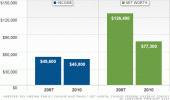
NEW YORK (CNNMoney) -- The average American family's net worth dropped almost 40% between 2007 and 2010, according to a triennial study released Monday by the Federal Reserve.
The stunning drop in median net worth -- from $126,400 in 2007 to $77,300 in 2010 -- indicates that the recession wiped away 18 years of savings and investment by families.
The Fed study, called the Survey of Consumer Finances, offers details on savings, income, debt, as well as assets and... (more)
Peter Schiff, CEO and chief global strategist at Euro Pacific Capital, explains why Washington's Keynesian approach to stimulating the economy has led to more overspending and excessive debt levels, during a Fraser Institute policy briefing on June 5 in Vancouver.
Casey Research chairman, author, and investor Doug Casey speaks to Cambridge House Live's Jonathan Roth at the June 4, 2012 World Resource Investment Conference in Vancouver.