|



Why won't the Obama administration reveal how many Americans' emails the NSA has collected and reviewed without a warrant?by Trevor Timm, Electronic Frontier FoundationEFF.org Jul. 02, 2012 |
Popular 
Mike Johnson Pushes Debunked Lie That Israeli Babies Were 'Cooked in Ovens' On October 7
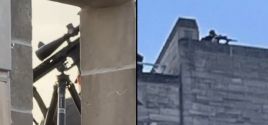
'Sniper Seen on Roof Overlooking Pro-Palestine Protest' at Indiana University

'It Has to Be Stopped': Netanyahu Demands Pro-Palestine Protests at U.S. Colleges Be Shut Down

Claim Jewish Student Was 'Stabbed In The Eye' by Pro-Palestine Protester Draws Mockery After Video Released

'These Protesters Belong in Jail': Gov. Abbott Cheers Arrest of Pro-Palestine Protesters at UT Austin

|
 Since last year, a few members of Congress--led by Senator Ron Wyden--have been trying to get the Obama administration to answer a simple question: how many Americans' phone calls or emails have been and are being collected and read without a warrant under the authority of the FISA Amendments Act of 2008 (FAA)? Unfortunately, no one else in the government seems to want that question answered. The question arose soon after Congress passed the FAA, which among other things sought to create immunity for telecoms that helped the NSA conduct warrantless wiretapping and gutted privacy protections for Americans communicating overseas. A New York Times investigation described how, under the FAA, a "significant and systemic" practice of "overcollection" of communications resulted in the NSA's intercepting millions of purely domestic emails and phone calls between Americans. In addition, documents obtained via a Freedom of Information Act request by the ACLU, although heavily redacted, revealed "that violations [of the FAA and the Constitution] continued to occur on a regular basis through at least March 2010"-- the last month anyone has public data for. The FISA Amendments Act is currently up for renewal, and Sen. Wyden, along with Sen. Mark Udall, wants the NSA to answer questions about these violations before Congress extends the law for five more years. "We have concluded"¦ that section 702 [of the Act] currently contains a loophole that could be used to circumvent traditional warrant protections and search for the communications of a potentially large number of American citizens," the Senators alleged. Yet not only have changes not been made to the law to address this vital concern, but the administration refuses to give the Senators any information on whether they're correct. Back in July 2011, the Office of the Director of National Intelligence told them "it is not reasonably possible to identify the number of people located in the United States whose communications may have been reviewed" under the FAA. Well, what about just a rough estimate? Last week, the Inspector General of the Intelligence Community officially responded for himself and the NSA Inspector General: "such an estimate was beyond the capacity of his [the NSA IG's] office and dedicating sufficient additional resources would likely impede the NSA's mission." Then, almost unbelievably, the NSA IG excused itself further from oversight by saying that "an IG review of the sort suggested would itself violate the privacy of U.S. persons." That's right. The government says that it would violate Americans' privacy for the NSA's inspector general to estimate how many Americans' privacy have been violated by the NSA. The loophole that Wyden is likely talking about appears to be so-called "back door" searches. As Wyden explains it, since communications are sucked up without an individual warrant under the FAA, there must "be clear rules prohibiting the government from searching through these communications in an effort to find the phone calls or emails of a particular American, unless the government has obtained a warrant or emergency authorization permitting surveillance of that American." The Senate Select Committee on Intelligence (SSCI) rejected an amendment stating that as well. SSCI chairman Dianne Feinstein insisted no such loophole existed, but still refused to support the amendment that would have cleared up any ambiguity. In response, Sen. Ron Wyden commendably put a 'hold' on the FAA's reauthorization in the Senate--a procedural maneuver that will at least temporarily keep the bill from going forward without debate--citing the potential massive privacy violations that the government will not explain to the American public. Unfortunately, the House has so far refused to compel such information as well. Two weeks ago, the House Judiciary Committee passed the re-authorization of the FISA Amendments Act 23-11, yet voted down all amendments that would have forced the government to be more transparent about the communications it had collected. Rep. Jackson-Lee's amendment--similar to Sen. Wyden's request--for an "estimate" on how many times Americans' emails have been read without a warrant was rejected, despite testimony from ACLU's Jameel Jaffer laying out all the evidence that dragnet surveillance of American's communcations was rampant. The Judiciary committee also rejected an amendment requiring the release of redacted FISA rulings--which are all classified--and a shorter re-authorization period. Yesterday, the House Permanent Select Committee on Intelligence (HPSCI) did the same thing, unanimously voting to extend the law for five years as well--again, with no known changes--and in secret. These bills both still need to be voted on by the full House and Senate before going to the President's desk, and without amendments adding robust oversight, transparency, and privacy protections, they should be voted down. Please call your member of Congress and tell them you strenously oppose the reauthorization of the FISA Amendments Act. |