|



There'll be nowhere to run from the new world government'Global' thinking won't necessarily solve the world's problems, says Janet DaleyThe Telegraph Dec. 22, 2009 |
Popular 
DOJ Indicts Jewish Group for 'Large-Scale, Decade-Long Insider Trading Scheme'

Ben Shapiro: Trump Should 'Just Blow Up Kharg Island'

Trump Expected to Pick Kevin Warsh, Son-in-Law of Zionist Billionaire Ron Lauder, as Fed Chair
Trump Appears Poised to Abandon 'Mass Deportations'

Mark Levin and Jonathan Pollard Push for Nuking Iran

|
 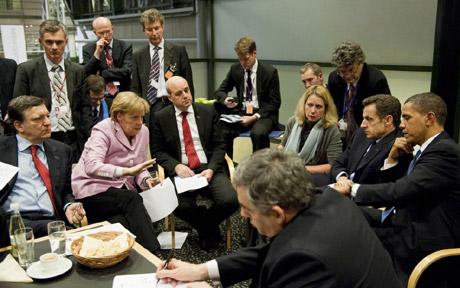 There is scope for debate – and innumerable newspaper quizzes – about who was the most influential public figure of the year, or which the most significant event. But there can be little doubt which word won the prize for most important adjective. 2009 was the year in which "global" swept the rest of the political lexicon into obscurity. There were "global crises" and "global challenges", the only possible resolution to which lay in "global solutions" necessitating "global agreements". Gordon Brown actually suggested something called a "global alliance" in response to climate change. (Would this be an alliance against the Axis of Extra-Terrestrials?) There is scope for debate – and innumerable newspaper quizzes – about who was the most influential public figure of the year, or which the most significant event. But there can be little doubt which word won the prize for most important adjective. 2009 was the year in which "global" swept the rest of the political lexicon into obscurity. There were "global crises" and "global challenges", the only possible resolution to which lay in "global solutions" necessitating "global agreements". Gordon Brown actually suggested something called a "global alliance" in response to climate change. (Would this be an alliance against the Axis of Extra-Terrestrials?)Some of this was sheer hokum: when uttered by Gordon Brown, the word "global", as in "global economic crisis", meant: "It's not my fault". To the extent that the word had intelligible meaning, it also had political ramifications that were scarcely examined by those who bandied it about with such ponderous self-importance. The mere utterance of it was assumed to sweep away any consideration of what was once assumed to be the most basic principle of modern democracy: that elected national governments are responsible to their own people – that the right to govern derives from the consent of the electorate. The dangerous idea that the democratic accountability of national governments should simply be dispensed with in favour of "global agreements" reached after closed negotiations between world leaders never, so far as I recall, entered into the arena of public discussion. Except in the United States, where it became a very contentious talking point, the US still holding firmly to the 18th-century idea that power should lie with the will of the people. Nor was much consideration given to the logical conclusion of all this grandiose talk of global consensus as unquestionably desirable: if there was no popular choice about approving supranational "legally binding agreements", what would happen to dissenters who did not accept their premises (on climate change, for example) when there was no possibility of fleeing to another country in protest? Was this to be regarded as the emergence of world government? And would it have powers of policing and enforcement that would supersede the authority of elected national governments? In effect, this was the infamous "democratic deficit" of the European Union elevated on to a planetary scale. And if the EU model is anything to go by, then the agencies of global authority will involve vast tracts of power being handed to unelected officials. Forget the relatively petty irritations of Euro‑bureaucracy: welcome to the era of Earth-bureaucracy, when there will be literally nowhere to run. But, you may say, however dire the political consequences, surely there is something in this obsession with global dilemmas. Economics is now based on a world market, and if the planet really is facing some sort of man-made climate crisis, then that too is a problem that transcends national boundaries. Surely, if our problems are universal the solutions must be as well. Well, yes and no. Calling a problem "global" is meant to imply three different things: that it is the result of the actions of people in different countries; that those actions have impacted on the lives of everyone in the world; and that the remedy must involve pretty much identical responses or correctives to those actions. These are separate premises, any of which might be true without the rest of them necessarily being so. The banking crisis certainly had its roots in the international nature of finance, but the way it affected countries and peoples varied considerably according to the differences in their internal arrangements. Britain suffered particularly badly because of its addiction to public and private debt, whereas Australia escaped relatively unscathed. That a problem is international in its roots does not necessarily imply that the solution must involve the hammering out of a uniform global prescription: in fact, given the differences in effects and consequences for individual countries, the attempt to do such hammering might be a huge waste of time and resources that could be put to better use devising national remedies. France and Germany seem to have pulled themselves out of recession over the past year (and the US may be about to do so) while Britain has not. These variations owe almost nothing to the pompous, overblown attempts to find global solutions: they are largely to do with individual countries, under the pressure of democratic accountability, doing what they decide is best for their own people. This is not what Mr Brown calls "narrow self-interest", or "beggar my neighbour" ruthlessness. It is the proper business of elected national leaders to make judgments that are appropriate for the conditions of their own populations. It is also right that heads of nations refuse to sign up to "legally binding" global agreements which would disadvantage their own people. The resistance of the developing nations to a climate change pact that would deny them the kind of economic growth and mass prosperity to which advanced countries have become accustomed is not mindless selfishness: it is proper regard for the welfare of their own citizens. The word "global" has taken on sacred connotations. Any action taken in its name must be inherently virtuous, whereas the decisions of individual countries are necessarily "narrow" and self-serving. (Never mind that a "global agreement" will almost certainly be disproportionately influenced by the most powerful nations.) Nor is our era so utterly unlike previous ones, for all its technological sophistication. We have always needed multilateral agreements, whether about trade, organised crime, border controls, or mutual defence. If the impact of our behaviour on humanity at large is much greater or more rapid than ever before then we shall have to find ways of dealing with that which do not involve sacrificing the most enlightened form of government ever devised. There is a whiff of totalitarianism about this new theology, in which the risks are described in such cosmic terms that everything else must give way. "Globalism" is another form of the internationalism that has been a core belief of the Left: a commitment to class rather than country seemed an admirable antidote to the "blood and soil" nationalism that gave rise to fascism. The nation-state has never quite recovered from the bad name it acquired in the last century as the progenitor of world war. But if it is to be relegated to the dustbin of history then we had better come up with new mechanisms for allowing people to have a say in how they are governed. Maybe that could be next year's global challenge. Comments Here |