|



Supreme Court Effectively Says There's No Way To Challenge Warrantless Wiretappingby Mike MasnickTechdirt Feb. 28, 2013 |
Popular 
Claim Jewish Student Was 'Stabbed In The Eye' by Pro-Palestine Protester Draws Mockery After Video Released

Mistrial Declared in Case of Arizona Rancher Accused of Killing Migrant Trespasser

Sen. Hawley: Send National Guard to Crush Pro-Palestine Protests Like 'Eisenhower Sent the 101st to Little Rock'
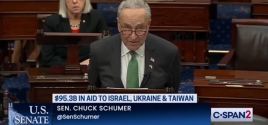
Senate Passes $95B Giveaway to Israel, Ukraine, and Taiwan, Combined With TikTok Ban

AP: 'Israeli Strikes on Gaza City of Rafah Kill 22, Mostly Children, as U.S. Advances Aid Package'

|
 This probably won't come as a surprise to anyone, but the Supreme Court has completely shot down the ACLU (and some activists and journalists') attempt to invalidate the part of the FISA Amendments Act that "legalized" warrantless wiretapping. As we guessed at the time of the oral hearings, it seemed like it was going to be difficult to convince a majority of the court that the plaintiffs had any standing to complain, since they couldn't show that they had been directly impacted. And, indeed the court ruled 5 to 4 that there was no standing here. So, basically, there is simply no way to challenge the constitutionality of warrantless wiretaps. Doesn't that seem like a serious constitutional problem? The government can pass laws that it can spy on people in private, and there's no way to then challenge that law. Oh, and if you happen to discover (by accident!) that you've been spied upon the government can just claim sovereign immunity, and that's it. Case closed. The full ruling is pretty depressing. The court basically says any harm is "speculative," and thus there can't be any standing at all. We decline to abandon our usual reluctance to endorse standing theories that rest on speculation about the decisions of independent actors.That's from the majority ruling, written by Justice Alito, and signed by Justices Roberts, Thomas, Scalia and Kennedy. Dissenting were Justices Breyer, Ginsburg, Sotomayor and Kagan. The majority also rejected the idea that merely having to take precautions not to be spied upon without warrants represents a real harm that gives standing: If the law were otherwise, an enterprising plaintiff would be able to secure a lower standard for Article III standing simply by making an expenditure based on a nonparanoid fear.Perhaps a legitimate concern, but it still seems somewhat ridiculous that there is no actual way to test the constitutionality of a law that clearly has 4th Amendment consequences. The dissent pointed out that it's crazy to suggest that the fact that this will be used on the plaintiffs was "speculative," and clearly worried about the implications of such a ruling and what it means for the government's ability to pass these kinds of laws without real judicial review. The upshot is that (1) similarity of content, (2) strong motives, (3) prior behavior, and (4) capacity all point to a very strong likelihood that the Government will intercept at least some of the plaintiffs’ communications, including some that the 2008 amendment, §1881a, but not the pre-2008 Act, authorizes the Government to intercept. At the same time, nothing suggests the presence of some special factor here that might support a contrary conclusion. The Government does not deny that it has both the motive and the capacity to listen to communications of the kind described by plaintiffs. Nor does it describe any system for avoiding the interception of an electronic communication that happens to include a party who is an American lawyer, journalist, or human rights worker. One can, of course, always imagine some special circumstance that negates a virtual likelihood, no matter how strong. But the same is true about most, if not all, ordinary inferences about future events. Perhaps, despite pouring rain, the streets will remain dry (due to the presence of a special chemical). But ordinarily a party that seeks to defeat a strong natural inference must bear the burden of showing that some such special circumstance exists. And no one has suggested any such special circumstance here.They go on to point to a series of other cases where standing was granted based on "probable" injury. It also notes a bunch of scenarios that seem ridiculous, but which are logically implied by this ruling. And, indeed, the standard the Supreme Court ruling makes here is a very high bar that is going to deny standing in many cases, and often allow the government to act with impunity in cases where oversight is needed. This is very unfortunate. And, of course, it's unlikely that Congress will do its job and step in to fix this. 11 1025 Ihdj (PDF) |